
Are you following a vegan diet, perhaps only eating around 1,200 calories a day and still not losing weight?
You think you’re doing everything right – eating in a huge calorie deficit, exercising daily, yet you aren’t seeing any weight loss, perhaps even seeing weight gain? Hungry, tired and frustrated you keep on going, hoping to one day see the scale start to go down. You tell yourself maybe your body just needs a bit more time to adjust to your new eating and exercising schedule.
Table Of Contents
You consume fewer and fewer calories on your restricted diet to try and reach your weight loss goals, surely the scale has to start going down. Well, this actually isn’t necessarily the case at all. Yes, weight loss does happen when you eat in a calorie deficit. However, it’s not all about the vegan foods you’re eating and the quantity you’re eating. There’s so much more that goes into weight loss than just your calorie intake. In this article, we delve deeper into the reasons you may not be losing weight even on a plant-based diet.
I’m Eating In A Calorie Deficit Yet I’m Not Losing Weight…Why?
There’s no quick cure or magic potion when it comes to having a successful weight loss journey – no matter what an ‘influencer’ or personal trainer might say! An 8-week beach body plan will ONLY work if you’re pretty much there anyway, or looking to get rid of the last few pounds.
Try to see your weight loss journey as a new plant-based lifestyle, full of nutrient-dense foods, not a quick fix. Don’t fixate on the end goal, enjoy the process and learn from your experiences.
Are Your Calories Too Low?
Yes, if you’ve created too much of a calorie deficit, that can actually make you GAIN body weight instead of losing it. It’s estimated, that in a healthy person your body burns on average 1,200 calories doing nothing but lying in bed all day. This is the amount of fuel your body needs just to survive. Fuel for things such as – breathing, pumping blood around your body, working your internal organs, blinking, healing wounds…etc.
For maintaining weight, it’s estimated women should be eating somewhere between 1600 – 2300 calories per day, depending on their activity levels. Whereas for a man it’s around 2300 – 3000 calories per day. The more active you are, the more calories you’ll need to maintain your energy levels, and your weight. You might even find the more you start to eat, the more your body fat starts to reduce on your new diet.
However, this doesn’t mean you should start to eat lots of white bread, ice cream, greasy potato chips, french fries and other processed foods. Instead, fill yourself up on whole foods, full of healthy fats and leafy greens.
Food options such as nut butters and avocados are great for getting more healthy fats through plant-based nutrition. A vegan protein powder is an ideal way to get enough protein. However, if you don’t like protein shakes, you can always eat things like black beans, sweet potatoes and even brown rice to top up your plant-based proteins.
The Calories You Need To Survive
So, say you’re cutting calories down to 1,200 calories a day (in a calorie deficit), which is the base amount your body needs to survive. Everything you’re eating is going into keeping you alive so your body goes into storage mode for survival. This could lead to weight gain!
EVERY calorie you put into your system, your body will store. It can’t afford to let anything go as it needs all the energy it can get. This means more fat will be stored in your cells.
In this storage mode, you might feel the cold more as all the energy you’re giving your body is going into working your major organs. You’ll feel lethargic most of the time and some people have been known to grow extra fuzzy hair across their bodies for extra warmth. Another reason why it’s a good idea to eat enough calories for your body type and activity level.
However, once you start to come out of your calorie deficit, and increase your daily calorie consumption, your body will slowly come out of starvation mode. When this happens, you should start to see the scale going down as your body lets go of the extra fat it’s stored up. So, if you’re eating very low calories, maybe try putting together a meal plan where you’re eating a bit more each day and see if that helps.
You Have A Slow Metabolism
Another reason you might be gaining weight on such a low caloric intake could be due to you having a slow metabolism. Having a slow metabolism generally comes from undereating in a calorie deficit for long periods of time.
Again, this is due to your body going into starvation mode. It slows down your metabolism to try to preserve as much energy for as long as possible. Your body will adapt to the amount of calories you put into it (within reason). So, if you have been underfeeding yourself for months or years, you’ve probably actually damaged your metabolism.
However, the good news is this generally isn’t permanent and can be fixed by doing a reverse diet. A reverse diet is where you SLOWLY begin to increase your calories from a calorie deficit. Maybe start with 50-100 extra calories a day, and work up to somewhere more around the base levels mentioned above for men/women. Your body will start to get used to having more calories given to it and gradually increase your metabolic rate again.
Related Post – How To Naturally Boost Your Metabolism
Additionally, those who want to boost their metabolism can also benefit from IV hydration along with a water-rich diet. IV treatment, delivers fluids and essential nutrients directly into the bloodstream, ensuring rapid absorption and hydration. It’s especially useful for those struggling with water intake, needing quick fluid replenishment for better weight loss results. Some individuals explore drip hydration as part of a comprehensive approach to health, including options like medical weight loss in New Jersey or any other location near them.
Don’t Fixate On The Scales
If you’re trying to lose weight, you might think weighing yourself every day is a good thing to do. However, this could actually be damaging your progress and is an easy way to make you think you’re not doing enough. Also, weighing yourself every day isn’t going to help your mental health!
Just because the scale weight might not be going down, doesn’t mean you aren’t losing fat. That extra weight could be water content your body has stored after eating a fast food meal, or if you had something salty. It could also be down to your hormone cycle. Around that time of the month (ladies), you’re more likely to be holding on to excess water and fat, causing you to look and feel more bloated.
What you might be losing in fat weight, you could well be gaining in muscle weight. Muscle weighs more than fat so you could be seeing your muscle mass increasing – hence why the scale is going up when you expect to lose weight.
Instead, try measuring yourself and taking progress photos once a week. This will give you a much more accurate way of knowing how you’re progressing. You might see that you’ve lost an inch around your stomach without even knowing it!
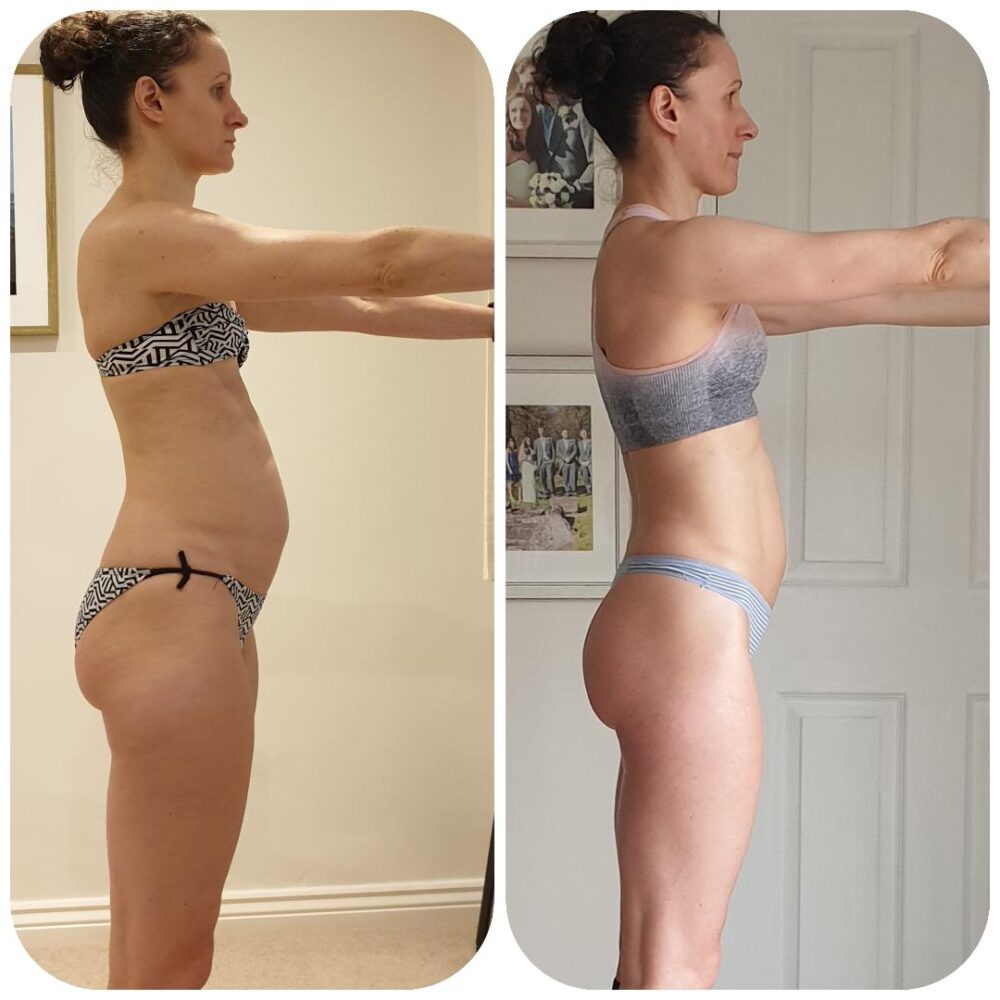
These two comparison photos are roughly 6 months apart. The first I was eating around 1,500 calories and over-exercising and in the second I was eating around 2,400 calories and exercising 4 times per week. My weight in both photos is roughly the same so what I lost in fat, I gained in muscle. I wanted to share these photos with you as proof you can lose fat and change your body mass index (BMI) by increasing your calorie density on a healthy diet.
How Do I Calculate My Calorie Deficit?
Tracking your calories incorrectly is very common. It can be very easy to incorrectly calculate your calories. For example – say you track 1 teaspoon of peanut butter. It should be one flat teaspoon of peanut butter.
However, you’ve been having a heaped teaspoon instead of a flat one. Right there the difference in calories could easily be 100 – 200 calories. The same with things such as olive oil, spreads, jams, sauces…etc. Most of these things are VERY calorific and are commonly either forgotten about when it comes to tracking or calculated wrongly.
Related Post – Can Technology Help You Lose Weight
Try using an app such as My Fitness Pal and track out ALL your food by weighing every item. This will give you a much better idea of how much you are consuming daily.
Once you know how much you’re eating day to day, try tracking it for a week to see if your weight goes up or down. If your weight stays where it is, you’re eating at maintenance. If it goes up, you’re in a surplus, and if it goes down, you’re in a calorie deficit.
Each week, try increasing your calories by 50 to 100 calories per day and see what happens to your weight. You might find your weight starts to go down!
Am I Over Exercising?
Another very common thing for people to do while trying to lose weight is to over-exercise for calorie burning. When you’re eating 1200 calories a day and not losing weight, desperation can set in.
The combination of under-eating and over-exercising could be doing you more harm than good. If your body feels overworked, under-fuelled and tired, it’s likely to be stressed and tense. You’re not giving it time to heal properly in between workouts or giving it the nutrients it needs to replenish its stores.
Your body can adapt to anything you throw at it, including being overworked. When overworked, it will again try to hold on to anything you fuel it with, holding on to fat for energy and preventing fat loss. You MUST give your body time to adapt if you’re new to exercise but you must also give it the fuel it needs to thrive.
It’s like not putting enough fuel in your car and expecting it to keep on going. At some point, it’s going to break down if you don’t re-fuel it.
You should avoid excessive amounts of cardio. Depending on your fitness levels, maybe just try doing cardio twice a week and opt for a HIIT workout instead. This won’t put as much strain on your body as it’s a much quicker option. However, it will give you more bang for your buck as it increases your heart rate for longer.
Related Post – Do Fitness & Dieting Go Hand In Hand?

Sleep & Stress
Two other aspects to consider if you struggle to lose weight is do you get enough sleep, and how much stress you have in your life.
For example, if you only ever get 4 or 5 hours of sleep per night, your body will never be able to give you 100% effort when you do exercise. It’s also likely the amount of physical activity you do throughout the day lessens. If you’re feeling tired, you probably aren’t going to feel like going to your exercise class. Or that walk you promised yourself you would do. Perhaps you take the lift instead of the of stairs, and when you get home, you flop in front of the TV. It might not seem like much, but this all adds up to your overall energy expenditure.
If you’re overly stressed you’re more likely to have health issues such as high blood pressure, or poor overall health in general. When people are stressed, they will either not eat much at all, leading to feeling even more tired. Or, they will make poor choices when it comes to food. Perhaps your portion control goes out of the window. Or you opt for high-calorie foods or vegan junk foods full of bad fats to make yourself feel better.
Easier said than done, but try to get at least 7 hours of sleep per night, and minimise your stress levels where possible.
Over Consuming Alcohol
Another reason why you might be eating a healthy balanced diet and not losing weight is the amount of alcohol you drink. Don’t forget it’s not just the food we put into our bodies that counts as calories. The liquid calories can be much more of a problem.
Alcoholic beverages are very often forgotten about when it comes to tracking food. In fact, alcohol is VERY calorific and can hugely affect the number of calories you are consuming daily. This could be the reason for your overall weight gain. If you like to have a glass of wine or beer then go for it, however maybe more in moderation and perhaps just one small glass.
Drinking alcohol will make your body prioritise trying to get these toxins out of your system as fast as it can, instead of any processing any food you’ve consumed. Meaning any food you have eaten won’t be used as fuel and instead will be stored as fat. Also, drinking alcohol will lead to hormonal suppression, resulting in a decrease in testosterone. Any time testosterone is decreased in the body, means you’re more likely to store the calories as fat.
If you try the tips above, you should start to see some significant weight loss. If you stick with it and give it some time, your hard work will begin to pay off.
This is so interesting! Calorie counting didn’t work for me for a while, I wonder if maybe these are some of the reasons why!
Jodie @ Jodetopia x
Hi Jodie, so glad you found it interesting. Yes, i t can be the smallest of things that make a difference. This article might also help you – https://thelifestylebloggeruk.com/6-simple-science-based-tips-to-naturally-boost-your-metabolism/